What Christ and Teddy Roosevelt teach us about serving others when our hearts ache
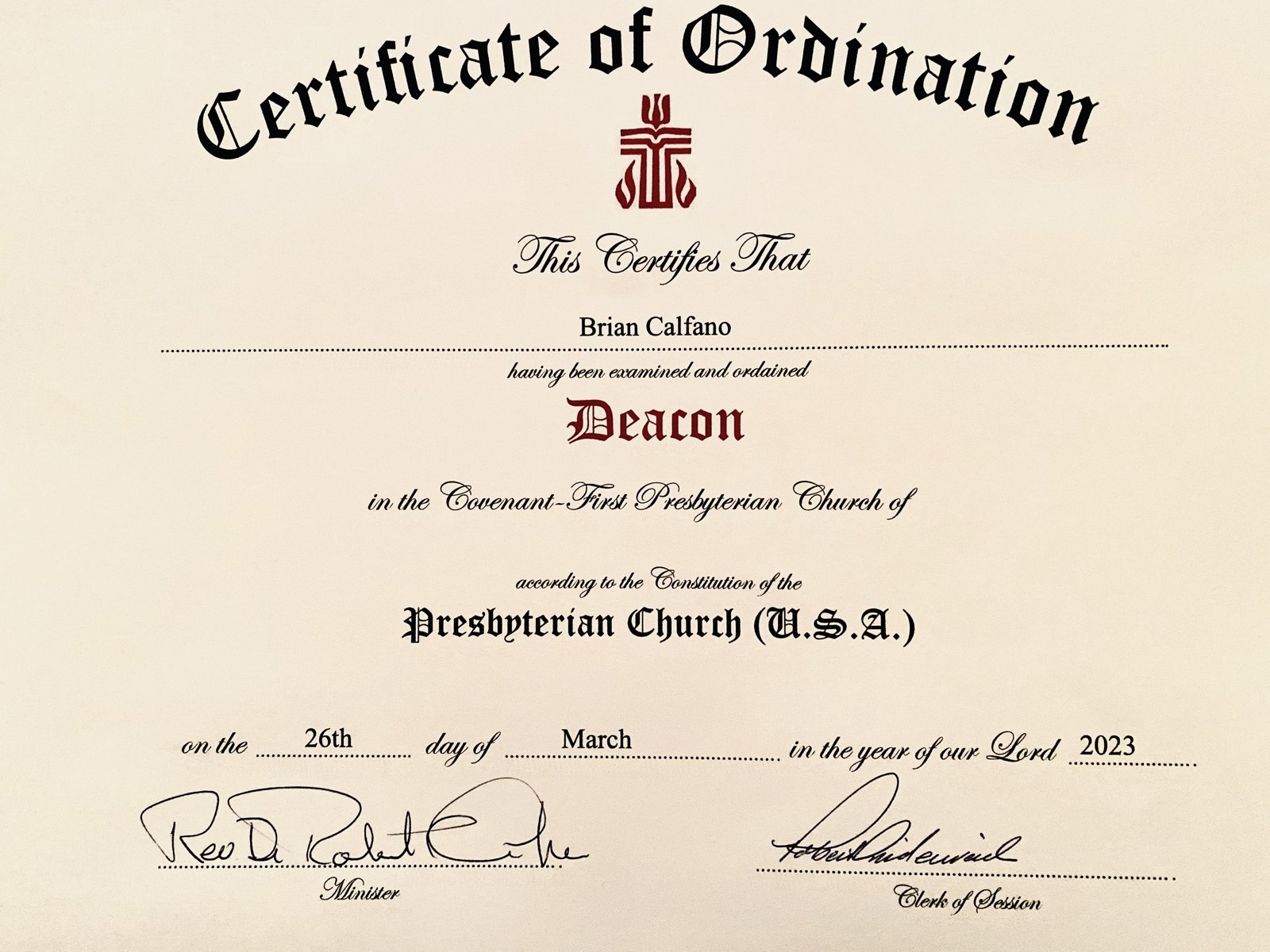
In the summer of 2023, I was a student in a ruling elder training program with the Presbyterian Church (U.S.A.). The culmination of the experience was delivering an original sermon at presbytery headquarters in Cincinnati. What follows is that sermon, as I preached it.
Brian Calfano · Cincinnati Presbytery · Summer 2023
Good evening. Our scripture reading for tonight is Matthew chapter 14, verses 13 through 21. Feel free to follow along as I read aloud.
The Reading · Matthew 14:13–21 (NKJV)
13 When Jesus heard it, He departed from there by boat to a deserted place by Himself. But when the multitudes heard it, they followed Him on foot from the cities. 14 And when Jesus went out He saw a great multitude; and He was moved with compassion for them, and healed their sick. 15 When it was evening, His disciples came to Him, saying, “This is a deserted place, and the hour is already late. Send the multitudes away, that they may go into the villages and buy themselves food.” 16 But Jesus said to them, “They do not need to go away. You give them something to eat.” 17 And they said to Him, “We have here only five loaves and two fish.” 18 He said, “Bring them here to Me.” 19 Then He commanded the multitudes to sit down on the grass. And He took the five loaves and the two fish, and looking up to heaven, He blessed and broke and gave the loaves to the disciples; and the disciples gave to the multitudes. 20 So they all ate and were filled, and they took up twelve baskets full of the fragments that remained. 21 Now those who had eaten were about five thousand men, besides women and children.
The word of the Lord. Thanks be to God.
Scripture taken from the New King James Version®. Copyright © 1982 by Thomas Nelson. Used by permission. All rights reserved.
One goal we have as Christians is to be more Christ-like, but we can’t perform miracles and we can’t stand as atonement for one another. So that leaves us to look to Jesus and his actions for examples of what we can accomplish within our very human limitations.
The miracle of feeding thousands of people with five loaves and two fish speaks to God’s awe-inspiring power through Christ Jesus. But our attention in this story usually goes to the food and the magnitude of what Jesus did on that day. I think, though, that there’s a Christ-like lesson in the text that we easily miss. That lesson hides in plain sight because we are so used to experiencing the feelings Jesus probably had.
In verse 13, Jesus had just learned that his cousin and friend, John the Baptist, was dead, murdered at the hands of Herod. At the end of chapter 13 in Matthew’s gospel, we learned that Jesus had faced rejection in his hometown. So it doesn’t take much for us to assume that Jesus, fully God and fully human, felt the way we would in similar circumstances: sad, lonely, abandoned, even betrayed. It’s hard to think of Jesus in these terms because, after all, he’s the Son of God. But in our passage, Jesus offers us a glimpse of the Christ-like example we can follow when our hearts are broken.
In Matthew 14, Christ shows us the example of action. Now, action — we can all relate to action as an example, right? Teddy Roosevelt did. You may or may not be a fan of our 26th president; TR had both admirers and critics. But one piece of advice he’d frequently give people was “get action.” In other words, do something. Do something, especially when times are the darkest.
In the span of Roosevelt’s long career, most forget that Teddy knew well how Jesus must have felt when verse 13 says our Savior “withdrew by boat privately to a solitary place.” You see, long before Teddy sat in the White House, biographers say that his wife, Alice, unlocked a romanticism in Roosevelt that perhaps none had seen in him before.
On February 12, 1884, Alice gave birth to their first child, a baby girl. Upon hearing this news, Teddy bolted from his office in Albany, the New York State Capitol. He was a politician in New York at the time, and he wanted to get back home to New York City and his beloved. But as Roosevelt arrived in the doorway of his home several hours later, his younger brother, Elliott, greeted him with a pale look on his face and told TR, “There’s a curse on this house.”
In the hours since Roosevelt left Albany, his mother, Mittie, who lived with Teddy and Alice, had taken seriously ill. In the words of historian H.W. Brands, Mittie was burning up with the fever of typhoid. There was nothing anyone could do. Alice was battling a kind of kidney failure as a result of childbirth. Roosevelt spent the next 16 hours at one bedside or another. His heart drew him toward Alice, but his mother seemed to be slipping faster. And indeed she went first, succumbing in the darkest pre-dawn hours of Thursday, February 14 — Valentine’s Day.
A sleepless Roosevelt climbed the stairs once more to Alice’s bedside. His vigil availed no more. In the early afternoon of the same day, Alice breathed her last. In his diary, Teddy drew a big black X over the Valentine’s Day page and wrote:
“The light has gone out of my life.”
Sad, lonely, abandoned, betrayed. Roosevelt was reeling — stunned, immobilized, alone. And who among us wouldn’t be? It’s here that Jesus offers the example we can follow. When all Jesus wants to do is be by himself to grieve John’s death, his heart is broken. But Christ shows us in those moments that responding to what others need may be the best balm for the heart.
In our scripture, Jesus meets the needs of thousands upon thousands of people in a single day — healing them, feeding them, and teaching his disciples, indeed all of us, that we too can serve others by meeting their most basic needs, even in our periods of grave pain, sorrow and despair.
Now let me be clear. Serving others when we’re struggling does not make the source of the pain vanish. Nowhere do we find Jesus acting like John’s death stopped hurting for him. And yes, people experiencing long-term depression, anxiety and other challenges should seek out medical care. There is no shame in using the gifts of science to empower our personal wellness. But we have more than science on our side. And in fact, science in this case stands with Christ.
For example, a randomized controlled study by psychologists at The Ohio State University, published earlier this year, finds that “something as simple as helping other people can go above and beyond other treatments in helping heal people with depression and anxiety.” Part of what Christ exemplifies for us in Matthew 14, and is the scientific reality we just talked about, is that to “get action” on behalf of others helps us in turn. It helps mend our broken hearts.
And Teddy Roosevelt realized this too. According to Brands, two days after the double funeral, TR wrote a friend, “I shall come back to my work.” A better therapy for a grieving man couldn’t have been prescribed.
So, my friends, where can you get action in your times of vulnerability and despair? What are the places and times in your life when you can follow Christ to serve others in your time of woundedness? Because we all have those times. If you look carefully, you’ll find those times are all around you. They might be a call you don’t take, an event you avoid, a meeting you canceled — all because you’re nursing a heartbreak.
In Matthew 14, Jesus shows us he understood and lived those things too. He could have avoided the crowd on that day. He could have spent time alone with his thoughts. But Jesus made the decision to engage in helping people. And in doing so, he shows us how to help ourselves.
