
Why This Site Is Called "We Choose" — and What a Public Deadline Is Actually For
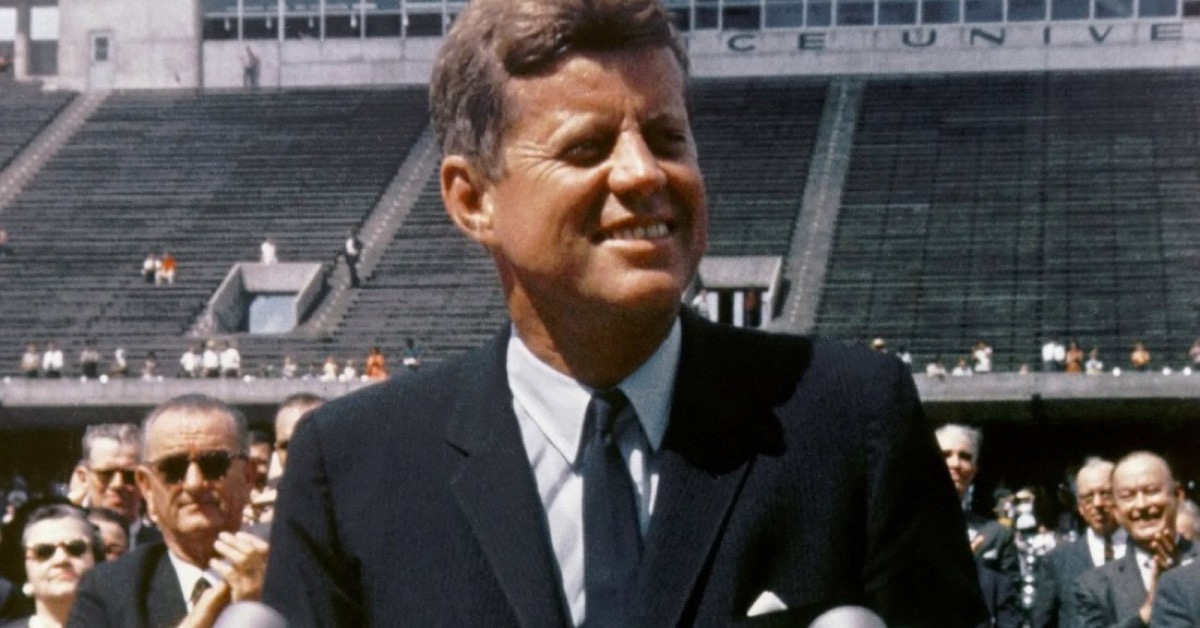
Sixty-four years ago today, John F. Kennedy stood in a football stadium at Rice University and said the sentence this site is named after: "We choose to go to the moon." Most retellings skip past it to the line everyone actually quotes — not because they are easy, but because they are hard — as though the point were difficulty for its own sake. The half that echoes in my thinking is the one that few remember: where JFK doubles down on his explanation. Kennedy does not say the country will go to the moon, or that it must, or that history demands it. He says a specific group of people, in a specific stadium, decided to. The goal is worth choosing, he adds, "because that goal will serve to organize and measure the best of our energies and skills." That is not a line about courage. It is a line about instrumentation — and it only works because something was chosen first. A hard goal with a date on it is a tool you use on yourself: it tells you what you have, what you are missing, and how fast you are closing the distance between them.
The other part that gets left out is how exposed he made it. He said it ahead of the evidence and admitted as much in the same breath, calling the program "in some measure an act of faith and vision, for we do not now know what benefits await us." Then he attached a clock to it that ran inside his own working life rather than somewhere safely over the horizon: "It will be done during the term of office of some of the people who sit here on this platform." Anyone can announce a hard goal. What made that one expensive was the date, the audience, and the fact that the people on the stage would still be around to be asked about it. Read the full transcript at the Kennedy Library and the speech is far less a piece of inspiration than a schedule delivered under oath.
I make documentaries, and documentaries do not end on their own. There is always another archive worth asking, another interview that might still come through, another pass on the cut that is entirely defensible as craft and also functions as delay. John Johnson Reporting got finished because at some point it had to be delivered and handed to people whose job was to judge it — the Telly Awards weighed it against more than 13,000 entries that year — not because we ran out of things we could have improved. The film that exists is not the film in the year-one outline. It is the film the archive allowed and the calendar forced, and I have stopped treating that as a compromise. That is what finishing is.
Reporting works the same way, faster. The three Colorado River stories I filed this August were reported in three weeks on assignment, headwaters in Wyoming down to a reservation near the Mexican border. An open-ended version of that assignment would not have produced better journalism. It would have produced notes. Research is where the problem is hardest to see, because the clock is private — a study can be revised indefinitely and every revision looks like rigor from the inside. My book on Johnny Carson is still in progress at LSU Press, and I notice it is also the project with the softest date on it. I do not think those two facts are unrelated.
That is why the company is called We Choose Media rather than something about storytelling, and it is why the name points at a decision rather than a subject. The speech is not really asking whether you prefer hard work to easy work — nobody prefers hard work. It is asking whether you will put your work somewhere it can be measured by someone other than you, on a day you named in advance, before you know whether it will hold up. Since late August this blog runs on Mondays and Thursdays instead of whenever a post happens to be ready, which is a much smaller version of the same bet and, on the weeks the argument is thin, an uncomfortable one. That is the whole point of it. The alternative is not easier work. The alternative is work you can always tell yourself is not finished yet.